
Tailored Surfaces
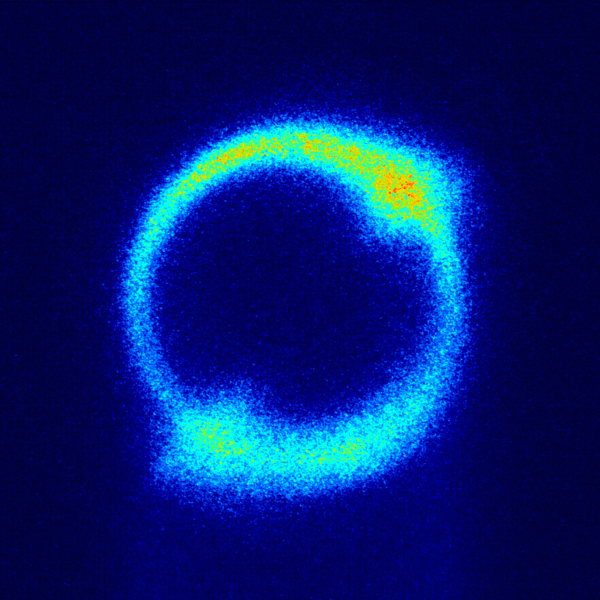
Understanding and precisely controlling plasmas — the foundation for reproducible film deposition
Plasmas are a central component of modern coating processes. At the IOM, they are systematically analyzed and characterized in order to better understand film growth processes and reliably produce thin films with defined properties.
Analysis of plasmas in coating processes
- Investigation of vacuum plasmas (e.g., HiPIMS, vacuum arc) and atmospheric plasmas
- Analysis of the composition, energy, and dynamics of plasma species
- Investigation of transport processes and interactions with surfaces
Diagnostic methods and measurement techniques
- Energy-resolved mass spectrometry
- Optical emission and absorption spectroscopy
- High-speed and streak imaging
- Probe-based measurements of particle flows
- Electrical characterization of plasmas
From plasma characterization to film properties
- Correlation of plasma parameters and material properties
- Derivation of process windows for reproducible coatings
- Contribution to the knowledge-based design of functional thin films
Contribution to the development of functional coating systems
- Understanding and control of plasma processes as the key to coating quality
- Basis for stable and scalable coating processes
- Support for the development of application-oriented thin films
- Close connection with deposition processes and materials development at the IOM
Projects
LiquidArc – A liquid-metal arc plasma source for high-rate deposition of semiconductor layers with large bandgaps
The goal of the “LiquidArc” research project is to develop, build, and test a novel liquid-metal arc plasma source for the high-speed deposition of crystalline, high-quality gallium oxide thin films with a wide bandgap that are suitable for semiconductor devices.
Funded by the DFG
Publication highlights
D. Kalanov, S. Mandazhiev, J. Franze, A. Anders, Y. Unutulmazsoy
Decoupling the effects of potential energy, kinetic energy, and ion flux on crystallinity of V-Al and V-Al-N thin films in pulsed filtered cathodic arc deposition
Surf. Coat. Technol. 497 (2025) 131720, DOI: 10.1016/j.surfcoat.2024.131720
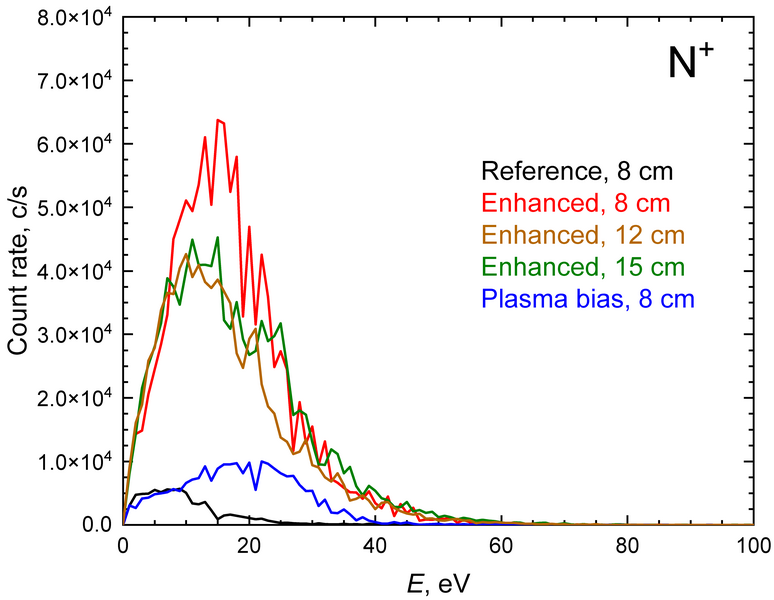
It is well known that thin-film deposition using filtered pulsed cathode arc plasmas produces dense and adherent thin films due to energetic ions carrying significant kinetic and potential energy. The role of the potential energy of multiply charged metal ions in film formation has not yet been sufficiently investigated, since the enhancement of charge states in cathode arcs is accompanied by an increased ion flux and kinetic energy. This work investigates the influence of the ions’ potential energy on the structural properties of thin films, while keeping the average kinetic energy of the ions constant. Two material systems are considered: metallic V-Al and the V-Al-N compound in non-reactive and reactive deposition, respectively. For V-Al plasma and thin films, the influence of the potential energy of the metal ions is demonstrated. In the case of V-Al-N, in addition to metal ions, activated (i.e., ionized, dissociated, and excited) nitrogen species also emerge as an important factor for the crystal growth of the metastable cubic phase.
D. Kalanov, J.W. Gerlach, C. Bundesmann, J. Bauer, A. Lotnyk, H. von Wenckstern, A. Anders, Y. Unutulmazsoy
Heteroepitaxial growth of Ga2O3 thin films on Al2O3(0001) by ion beam sputter deposition
J. Appl. Phys. 136 (2024) 015302, 10.1063/5.0211179
The deposition of epitaxial oxide semiconductor films using physical vapor deposition techniques requires a detailed understanding of the role of high-energy particles in order to control and optimize film properties. In this study, Ga2O3 thin films were grown heteroepitaxially on Al2O3(0001) substrates using oxygen ion beam sputter deposition. The influence of the following relevant process parameters on the properties of the thin films is investigated : substrate temperature, oxygen background pressure, primary ion energy, ion beam current, and sputtering geometry. Distributions of the kinetic energy of the ions in the film-forming flux are measured using an energy-selective mass spectrometer, and the resulting films are characterized in terms of crystal structure, microstructure, surface roughness, mass density, and growth rate. The energetic influence of the film-forming particles on the thin-film structure is analyzed, and a significant decrease in crystal quality is observed above the average energy of the film-forming Ga+ ions by 40 eV for films grown at a substrate temperature of 725 °C.
K. Oh, D. Kalanov, A. Anders
High-resolution observation of cathode spots in a magnetically steered vacuum arc plasma source
Plasma Sources Sci. Technol. 30 (2021) 095005, 10.1088/1361-6595/ac1ee1
The characteristics of cathode spots in a magnetically controlled vacuum arc plasma source were investigated. The cathode spots were observed using a remote microscope coupled to a streak camera, with the camera’s entrance slit aligned with one of the linear sections of the controlled arc source. This is a key feature that enables observation of the spots as they appear along the erosion path. The motion patterns of the spots and the patterns of the emitted light were observed at different sweep times. The streak images were analyzed using fast Fourier transform to verify the presence or absence of characteristic features such as characteristic lifetimes, as their existence remains controversial. We have found that the power spectrum of the arc spot fluctuations does not exhibit specific frequencies or associated times, but rather that the spot fluctuations exhibit a broad spectrum following a power-law relationship (spectral power density versus frequency), indicating the fractal (self-similar) nature of the spot processes. Furthermore, we show that under our conditions, at approximately 300 MHz, we reach the ultimate temporal resolution limit of the method, which is related to the finite lifetime of excited atomic and ionic states. This is a fundamental limit dictated by the physics of atoms and ions, and not a measurement error. The temporal resolution limit of approximately 3 ns also implies a spatial resolution limit on the order of a few μm, since the emitting species move laterally relative to the observation.
M. Rudolph, D. Kalanov, W. Diyatmika, A. Anders
Electron transport in high power impulse magnetron sputtering at low and high working gas pressure
J. Appl. Phys. 130 (2021) 24431, 10.1063/5.0075744
The magnetic field of a magnetron serves to prolong the residence time of the electrons in the ionization region, thereby enabling the discharge to be maintained at low operating gas pressures. This prevents the electrons from reaching the anode, which is necessary to close the circuit. At high atomic densities in the ionization region and in the presence of an electric field, collisions between electrons and heavy particles propel the electrons one after another across the magnetic field lines—a phenomenon known as the classical cross-field transport mechanism. At low atomic densities in the ionization region, collisions are rare, and the classical cross-field transport mechanism is insufficient to carry the discharge current. This leads to plasma instabilities, known as spokes, which provide local pathways for electrons to escape from the region near the target and cross the magnetic field lines. Here, we demonstrate experimentally, in the case of a high-power pulsed magnetron sputtering discharge with an aluminum target, how spokes gradually disappear as the local gas density increases. We present an analytical model showing that, under these high-gas-density conditions, the classical electron transport mechanism is in fact strong enough to carry the discharge current on its own. This underscores the importance of local gas density in the ionization region for the intensity of spokes in a magnetron sputtering discharge and provides insights for process optimization.
Equipment
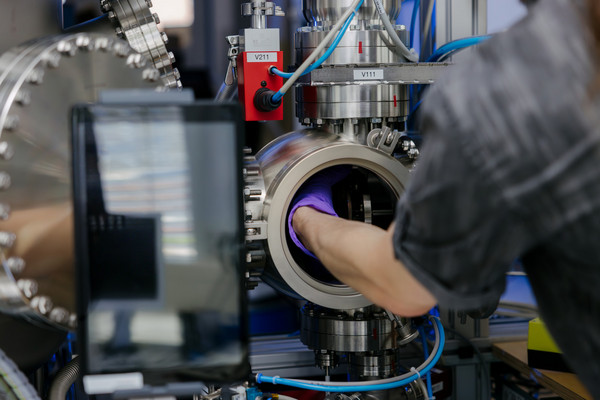
High-vacuum chambers
- Flexible platform for thin-film deposition and in-situ plasma monitoring
- Vacuum chamber for combinatorial magnetron sputter deposition
- Multifunctional large vacuum chamber for investigating pulsed ionized PVD (Physical Vapor Deposition) processes, including cathodic arc deposition and HiPIMS
Plasma diagnostic instruments
- Princeton Instruments PI-MAX4-1024f Gated iCCD Camera
- High-speed imaging camera: Specialized Imaging SIM4
- Hamamatsu C13410 streak camera
- Imaging spectrometers Princeton Instruments IsoPlane SCT320 and SCT160
- McPherson Model 234/302 VUV monochromator
- Questar QM-100 remote microscope
- Hiden EQP HE 1000 Mass and Energy Analyzer
- INFICON Cool Drawer™ quartz crystal microbalance
- Ion collector probe for pulsed plasmas