Tailored Surfaces
Miniaturized systems for personalized diagnostics and decentralized analytics
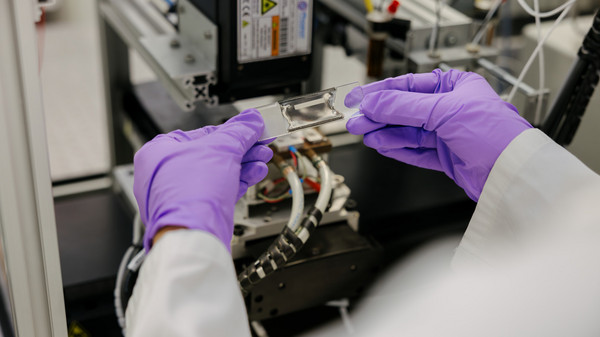
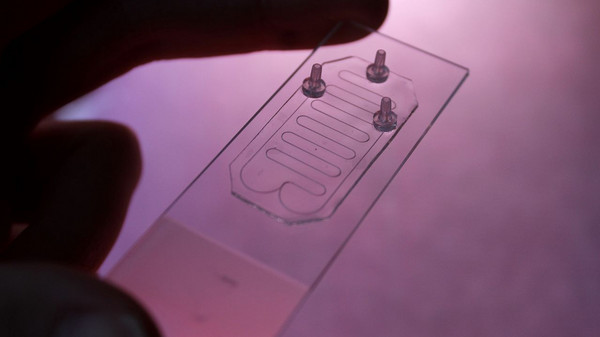
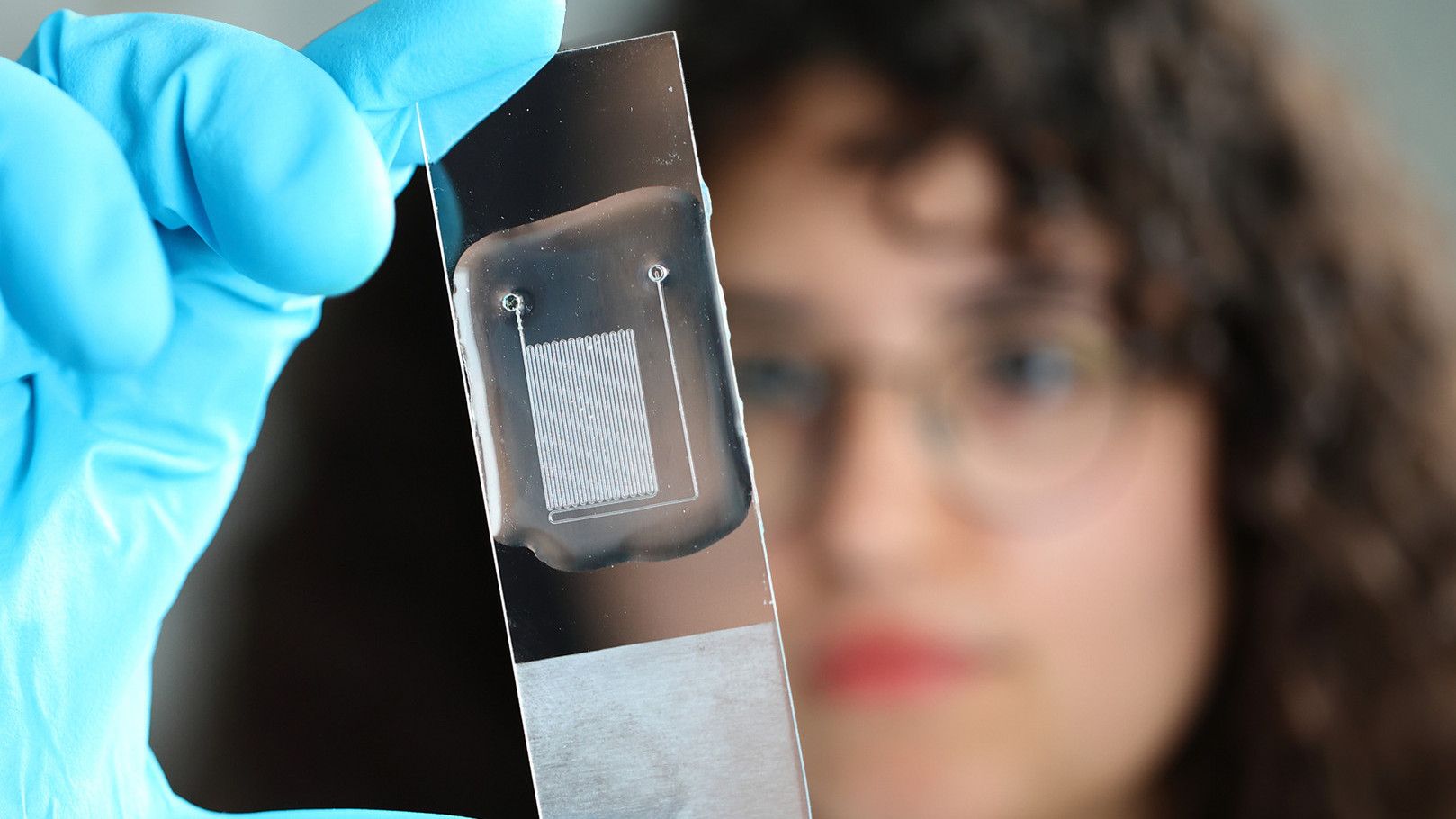
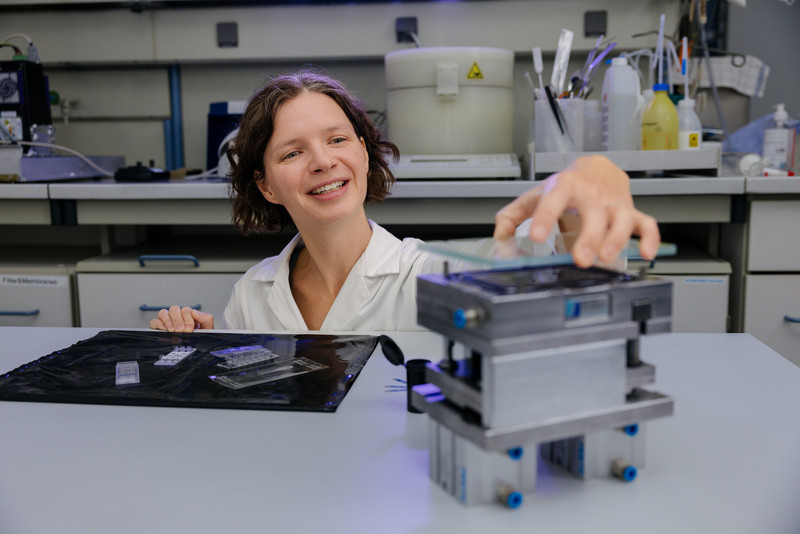
The IOM develops microstructured and microfluidic systems for biomedical applications. The goal is to create functional devices that enable complex analyses in the smallest of spaces and, in the long term, support personalized and decentralized medical care.
Development of microfluidic systems and components
- Design and fabrication of microfluidic devices and lab-on-a-chip systems
- Development of new polymer materials and functionalized microstructures
- Integration of various functions into compact and scalable systems
- Construction of prototypes for biomedical analysis and diagnostics
Manufacturing technologies and process development
- UV imprinting technologies (roll-to-roll and plate-to-plate)
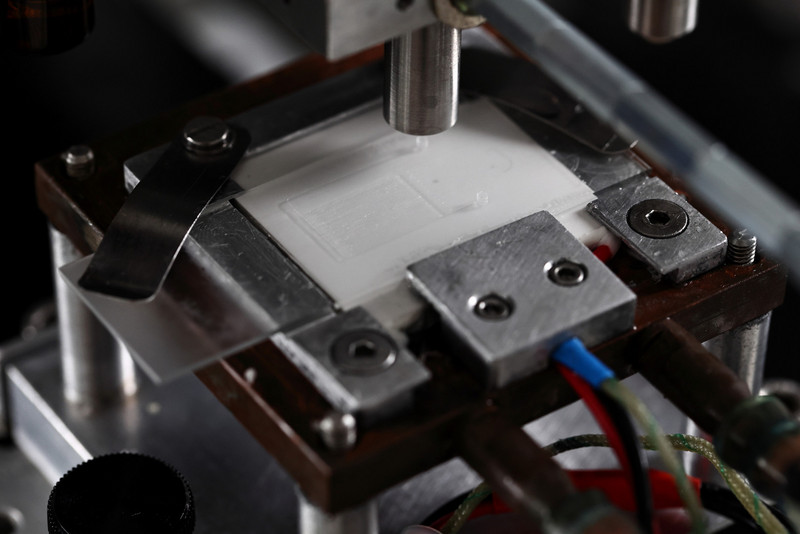
- Drop-on-demand printing methods (e.g., cryoprinting)
- Combination of various processes for prototype and mass production
- Development of efficient processes for scalable production
Functionalization and integration of new materials
- Integration of electrode materials, adsorbent phases, and molecular switches
- Incorporation of biomaterials and functionalized gels
- Use of stimulus-responsive and hybrid composite materials
- Radiochemical surface modification, e.g., using molecular templates
Contributions to personalized medicine and analytics
- Development of systems for decentralized diagnostics (point-of-care)
- Miniaturization of complex analytical methods
- Foundation for faster, individually tailored medical decisions
- Contribution to the integration of new technologies into application-oriented devices
Publikation highlights
E. Gärtner, F. Schell, L. Nitschke, R. C. Okafor, C. Zwahr, C. Hackl
Replicative production of multifunctional microfluidic polymer films for biomedical disposables
Procedia CIRP 125 (2024) 207-212, https://doi.org/10.1016/j.procir.2024.08.036
The increasing demands on the reproducibility and precision of lab-on-a-chip systems in the life sciences call for innovative methods for the selective surface functionalization of polymer films. The targeted laser-based micro- and nanostructuring of replication tools, particularly through Direct Laser Interference Patterning, enables the creation of localized properties relevant to wetting, such as hydrophobic or hydrophilic surfaces. The functional microstructures produced in this way are successfully transferred to polymer films via UV imprinting, and their effect on wetting behavior is verified.
R. Garmasukis, C. Hackl, C. Dusny, C. Elsner, A. Charvat, A. Schmid, B. Abel
Cryo-printed microfluidics enable rapid prototyping for optical-cell analysis
Microfluidics and Nanofluidics 27 (2023) 5, https://doi.org/10.1007/s10404-022-02613-4
Cryoprinting is an innovative and flexible rapid prototyping method for the fabrication of microfluidic chips, in which the microchannel structures are created through the controlled deposition of aqueous microdroplets as temporary ice microstructures, followed by encapsulation with a UV-curable polymer. The microfluidic chips produced in this way are successfully used for microfluidic cultivation and quantitative fluorescence microscopy analysis of various prokaryotic, eukaryotic, and phototrophic cell types, underscoring the potential of this printing technology for biological microfluidic applications.
T. John, J. Adler, C. Elsner, J. Petzold, M. Krueger, L.L. Martin, D. Huster, H.J. Risselada, B. Abel
Mechanistic insights into the size-dependent effects of nanoparticles on inhibiting and accelerating amyloid fibril formation
Journal of Colloid and Interface Science 622 (2022) 804-818, https://doi.org/10.1016/j.jcis.2022.04.134
The aggregation of peptides into amyloid fibrils plays a central role in age-related diseases such as Alzheimer’s and type 2 diabetes and is strongly influenced by interfacial effects. The study shows that the size and curvature of gold nanoparticles control fibril formation in a peptide-specific manner. Experiments and simulations demonstrate that high surface curvatures destabilize prefibrillar structures, providing important insights for the design of future nanostructured materials.
Verfahren und Vorrichtung zur Herstellung beidseitig mikrostrukturierter Verbundfolien, B. Gründig, C. Elsner, B. Abel, (2013), DE102013203829.1, DPMA
Patentschrift
Verfahren zur Herstellung eines Mikrosystembauteils, A. Charvat, C. Elsner, B. Abel, (2017), 10 2017 130 947.0, DPMA
Patentschrift
Equipment
- Various replication systems for UV imprinting using batch (plate-to-plate) and continuous (roll-to-roll) processes
- 3D printers for cryoprinting (drop-on-demand, UV inkjet)
- UV tape system
- Film application
- Atmospheric plasma
- Methods for the mechanical, optical, and thermal characterization of polymer films
Topics for Doctoral, Master’s, and Bachelor’s Theses
Academic theses on current topics are assigned on an ongoing basis. If you are interested, please contact Prof. Dr. S. G. Mayr.