Tailored Surfaces
Laser-based structuring for optics, photonics, and functional surfaces
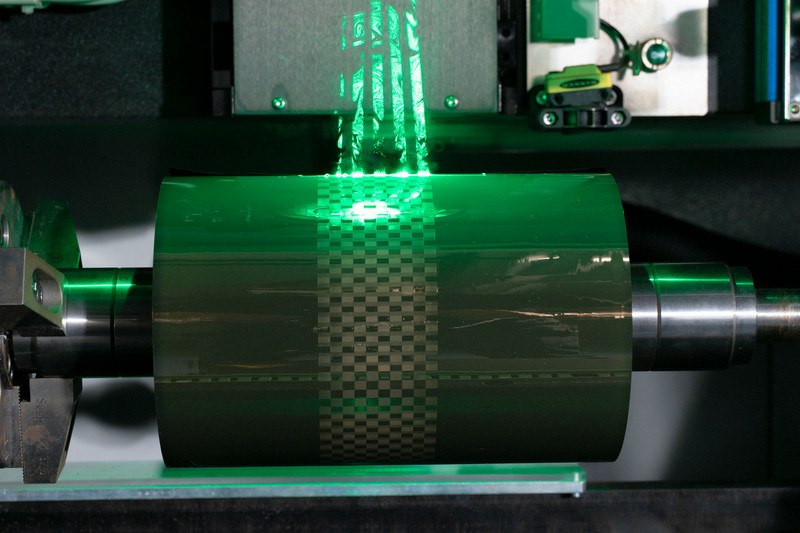
Laser-based processes expand the possibilities of ultra-precise surface processing — especially where the highest structural resolution, material diversity, and process speed are required. At the IOM, laser processes are being specifically developed to produce optical and functional surfaces with nanometer-level precision.
Laser-based micro- and nanostructuring
- Micro- and nanostructuring using ultrashort-pulse lasers
- Optimization of laser ablation through beam shaping and process strategies
- Development of processes using laser-induced plasmas
- Diagnostics and process control, e.g., via plasma spectroscopy
Applications in photonics and functional surfaces
- Structuring of optical components for photonics and precision optics
- Functional surfaces for sensor technology and industrial applications
- Complementary processes for the high-precision fabrication of complex components
Precision through the combination of physical and chemical effects
- Combination of physical and chemical processes for nanometer-precise structuring
- Control of material removal across all scales—from the atomic level to the component
- Integration of experimentation, diagnostics, and modeling
- Development of efficient and environmentally friendly processes for industrial applications
Projects
Research into the material-structure relationship for light-guiding elements in a composite protective film for flexible organic solar modules (FlexSolarProtect)
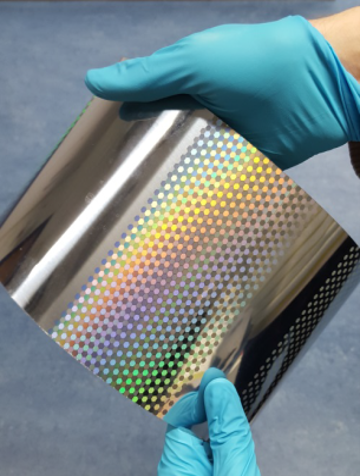
The project aims to integrate light-guiding structures into the front protective films to increase the efficiency of organic solar modules. These structures are to be specified and produced on a trial basis to demonstrate the process. Under the leadership of the Saxon photovoltaic manufacturer Heliatek GmbH, the IOM served as a research partner in the development of the light-guiding structures. These were ultimately applied to the front protective films developed by D-K Kunststoff-Folien GmbH via casting into high-refractive-index acrylate mixtures and were ultimately used to seal the organic photovoltaic cells.
Funded by BMFTR as part of the “WIR! – Change Through Innovation in the Region” funding program
Laser-stimulated reactive atmospheric-pressure plasma jet etching processes for ultra-precision machining of optical glasses (LasPlasJet)
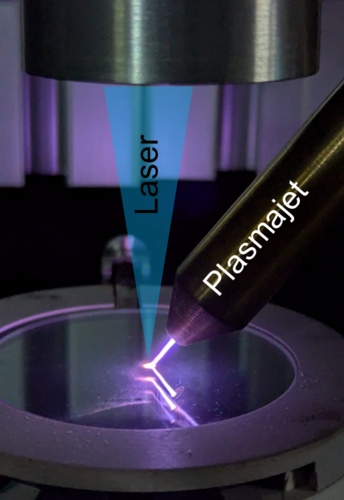
In reactive atmospheric-pressure plasma jet etching processes (Reactive Plasma Jet Machining, RPJE) of glass, the reaction of fluorine from the etched glass with the metal oxides contained in the glass results in the formation of a passivation layer consisting of fluoride-containing deposits. This passivation layer reduces the etching rate during etching and significantly increases the surface roughness of the glass. To achieve sequential or continuous removal of the passivation layer or to minimize its formation, the glass surface is irradiated with pulsed laser radiation in parallel with the RPJE process. The additional energy input from the laser photons causes the passivation layer to be ablated. As a result, the etching process can be carried out continuously, and the surface roughness is comparatively lower. These research results form the basis for the development of plasma jet-laser ultraprecision machining processes for glasses used in high-end optical applications.
Funded by the DFG
Research into processes for the efficient production of filter film composite systems using UV technologies
The project is being carried out as part of the collaborative project “Development of Microstructured Filter Systems via UV Replication at the Wafer Level for Their Application in Biomedicine” in cooperation with companies from Central Germany. The IOM’s developments aim to achieve residue-free replication of microstructured masters through UV curing of liquid, biocompatible prepolymers, as well as defect-free demolding of the replicates. These replicates subsequently form a self-supporting, very dense perforated film. A supporting structure is embedded in the perforated film for mechanical stabilization.
Funded by ZIM
Research into the material-structure relationship for light-guiding elements in a composite protective film for flexible organic solar modules (FlexSolarProtect)
The project aims to integrate light-guiding structures into the front protective films to increase the efficiency of organic solar modules. These structures are to be specified and produced on a trial basis to demonstrate the process. Under the leadership of the Saxon photovoltaic manufacturer Heliatek GmbH, the IOM served as a research partner in the development of the light-guiding structures. These were ultimately applied to the front protective films developed by D-K Kunststoff-Folien GmbH via casting into high-refractive-index acrylate mixtures and were ultimately used to seal the organic photovoltaic cells.
Funded by BMFTR as part of the “WIR! – Change Through Innovation in the Region” funding program
Publication highlights
K. Zimmer, J. Zajadacz, M. Ehrhardt, P. Lorenz, T. Smausz, B. Hopp
Transfer of photolithographic patterns by excimer laser ablation of polymers
Appl. Surf. Sci. Adv. 27 (2025) 100754, https://doi.org/10.1016/j.apsadv.2025.100754
Traditionally, pattern transfer is performed by plasma etching. Here, a laser-based transfer method is proposed and demonstrated, in which excimer laser ablation is used to transfer photolithographic photoresist masks onto polyimide substrates. In the experiments, laser fluence and pulse rate were varied to understand the transfer process and the associated optical, thermal, and mechanical effects that cause specific topographical features and changes in the structure’s shape.
J. Zajadacz, P. Lorenz, M. Ehrhardt, K. Zimmer
Development platform for UV-NIL processes using polymer masters produced by laser ablation and photolithography
Nanotechnology and Precision Engineering 8 (2025), https://doi.org/10.1063/10.0034395
An approach was developed that combines direct laser writing and photolithography to produce polymer masters for use in roll-to-roll NIL (nanoimprint lithography) replication. The photolithographically and laser-structured surfaces were precisely laser-cut, assembled, and finally cast into inverse silicone stamps, which are used for roll-to-roll replication. This combination of sub-processes allows for the use of standard laboratory equipment for patterning and reduces both costs and time required for master fabrication. Finally, high-quality replication in an acrylate formulation was demonstrated.
P. Lorenz, J. Zajadacz, A. Lotnyk, J.W. Gerlach, M. Ehrhardt, R. Kirchner, K. Zimmer
Fabrication of plasmonic microcubes by laser ablation of Au-nanoparticles-loaded acrylate
Physica status solidi (a) 221 (2024) 2300481, https://doi.org/10.1002/pssa.202300481
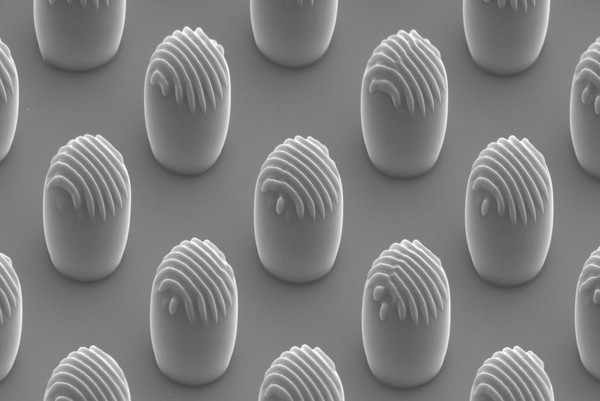
Plasmonic microstructures enable a wide range of applications, from sensor technology to energy harvesting. Here, we demonstrate a novel two-step fabrication process that involves the preparation of an acrylate film doped with gold particles and subsequent laser patterning. The cubes are fabricated with precise size and shape by controlling the layer thickness of the acrylate film during spin coating and defining the path during UV femtosecond laser writing to determine their lateral dimensions. The plasmonic microcubes, measuring just 15 µm, exhibit the expected plasmon resonance near 550 nm.
A. Bernhardt, P. Lorenz, K. Fischer, M. Schmidt, M. Kühnert, A. Lotnyk, J. Griebel, N. Schönherr, K. Zimmer, A. Schulze
Laser-crystallization of TiO2 nanotubes for photocatalysis: influence of laser power and laser scanning speed
Laser & Photonics Reviews (2024) 2300778, https://doi.org/10.1002/lpor.202300778
This study investigates the laser crystallization of amorphous titanium dioxide nanotubes to produce photocatalytically active anatase and rutile phases. The nanotubes, synthesized via an anodization process, are irradiated with femtosecond laser pulses, with both the laser power and the scanning speed varied. An increase in laser power led to a gradual transition from the amorphous phase to anatase and subsequently to rutile, confirming a thermal crystallization mechanism. The resulting laser-crystallized anatase samples exhibited similar photocatalytic degradation rates of methylene blue as traditionally calcined samples, underscoring the applicability of the method.
E. Bez, M. Himmerlich, P. Lorenz, M. Ehrhardt, A. Graham Gunn, S. Pfeiffer, M- Rimoldi, M. Taborelli, K. Zimmer, P. Chiggiato, A. Anders
Influence of wavelength and accumulated fluence at picosecond laser-induced surface roughening of copper on secondary electron yield
J. Appl. Phys. 133 (2023) 035303, https://doi.org/10.1063/5.0131916
This study investigates the influence of wavelength and cumulative fluence on the surface properties and secondary electron yield (SEY) of copper processed with a picosecond laser. Laser-structured surfaces exhibit hierarchical micro- and nanostructures that can reduce the SEY and help mitigate electron cloud effects in particle accelerators. The researchers found that a higher cumulative laser fluence leads to deeper grooves, more nanostructures, and a reduced SEY. All wavelengths examined (UV to IR) achieved SEY values below the critical threshold of 1, which is the target for applications in particle accelerators. The results provide important insights for optimizing laser processing parameters for vacuum components in current and future accelerators, such as the Large Hadron Collider (LHC).
Equipment
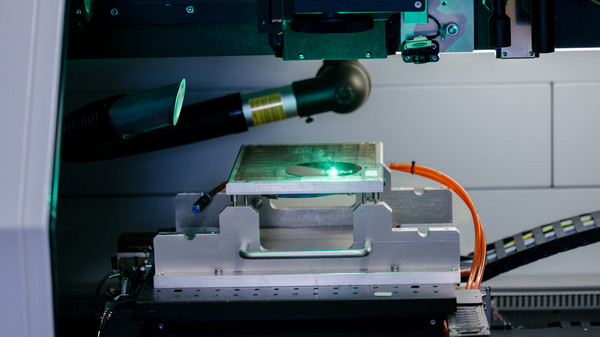
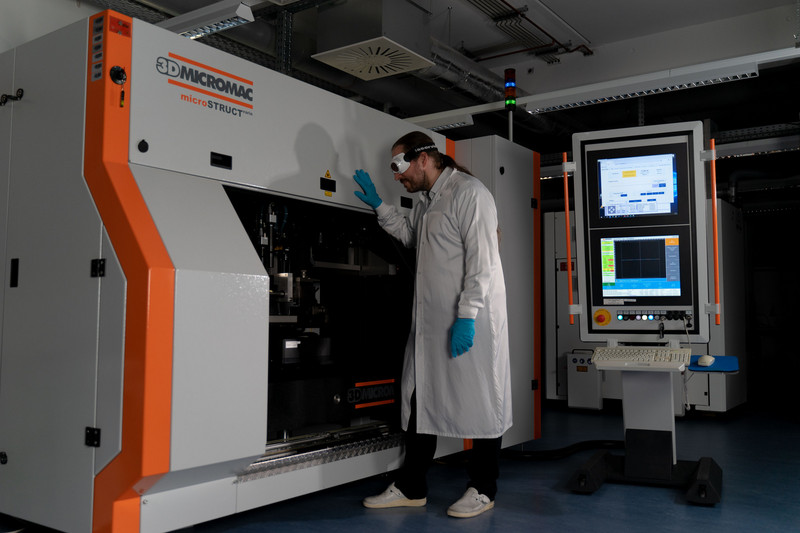
- Ps-fs Laser System
for microstructuring flat and free-form surfaces using ultrashort laser pulses.
Wavelength: 343 nm, 515 nm, 1030 nm
Pulse duration: 260 fs – 10 ps - IR nanosecond laser system
for structuring surfaces using nanosecond laser pulses. The built-in 1064 nm laser allows for free adjustment of the pulse duration, enabling the precise control of thermal laser processes.
Wavelength: 1064 nm, 1550 nm
Pulse duration: 1 – 600 ns - UV Nanosecond Laser System
for the micro- and substructuring of surfaces, particularly polymers , and dielectrics, using nanosecond laser pulses in conjunction with
projection optics.
Wavelength: 248 nm
Pulse duration: 25 ns - Fs Laser System
for structuring surfaces and generating microplasmas in reactive atmospheres for dry chemical etching of surfaces.
Wavelength: 775 nm
Pulse duration: 150 fs - 2PP/laser lithography system
for generating 3D microstructures via two-photon polymerization using femtosecond laser radiation. Furthermore, the system enables laser lithography of free-form surfaces, particularly for optical applications.
fs laser: Wavelength = 780 nm, pulse duration = 71 fs
Cw laser: Wavelength = 405 nm - UV Nanosecond Laser/Plasma Jet System
Coupled laser-plasma jet system for high-precision patterning of technical glasses for optical applications.
Excimer laser: Wavelength = 248 nm, pulse duration = 25 ns
Microwave-induced plasma jet (APPJ): Peak power = 300 W, pulse duration = 5–30 µs, maximum average power = 30 W
Themen Promotions- Master- und Bachelorarbeiten
Masterarbeiten
- Strukturübertrag durch Laserablation: Untersuchung des Einflusses von Parametern auf Veränderungen der Strukturform
Die Strukturübertrag durch Laserablation ist ein neuer, umweltfreundlicher Ansatz zur Mikrostrukturierung ohne Vakuum und reaktive Gase. Die Veränderungen der Höhe, Größe und Form der Mikrostrukturen müssen in Abhängigkeit der Laser- und Prozessparameter experimentell untersucht werden. Die durch Lithografie hergestellten Mikrostrukturen werden UV-Laserstrahlung ausgesetzt, um Maske und Substrat gleichzeitig abzutragen. Die geometrischen, morphologischen und topografischen Veränderungen werden mittels Bildgebungsverfahren ermittelt.
- Hochselektive Strukturübertragung durch RPJ-Ätzen
Die Strukturübertragung wird für die mikroelektronische Strukturierung von Funktionsschichten genutzt, erfordert jedoch teure Vakuumanlagen und reaktive Gase. Ein neuer Ansatz nutzt das Ätzen mit atmosphärischem Plasmastrahl zur Strukturübertragung in Silizium und Siliziumdioxid. Die Tiefe der übertragenen Struktur wird durch die Selektivität des Ätzprozesses bestimmt, die durch das Maskierungsmaterial und die Prozessparameter eingestellt werden kann. Daher sind experimentelle Untersuchungen geplant, um den Einfluss der Prozessparameter auf die Selektivität des Ätzprozesses aufzuklären.
- RPJ-Ätzung von laserbehandeltem Material
Die Bestrahlung von Materialien mit ultrakurzen Laserimpulsen verursacht Schäden am Material, die zu chemischen und strukturellen Materialveränderungen führen. Da die physikalischen und chemischen Materialeigenschaften von der Struktur des Materials abhängen, ist die Korrelation zwischen laserinduzierten Materialveränderungen und der daraus resultierenden Verarbeitbarkeit erforderlich, um potenzielle Anwendungsbereiche zu erkennen.
- Mikrostrukturierung von gekrümmten und nicht-ebenen Glasoberflächen durch Laserlithografie und reaktives Plasmastrahlätzen
Für Hybridoptiken, die diffraktive und refraktive Elemente kombinieren, ist eine effektive und reproduzierbare Mikrostrukturierung von Glasoberflächen erforderlich. Die Herstellung hybrider optischer Oberflächen erfordert hochspezialisierte Verfahren. Ziel ist es, Laserlithografie und reaktives Plasmastrahlätzen zu kombinieren sowie Prozessparameter und Bearbeitungsstrategien festzulegen, um hochwertige Hybridoptiken zu realisieren.
Bachelorarbeiten
- Selektives Ätzen von lasermodifiziertem einkristallinem Silizium zur Erzeugung von 3D-Strukturen
Das kristallorientierte Ätzen von einkristallinem Silizium (c-Si) mittels Oberflächenmaskierung ist bekannt und wird für Anwendungen in Mikrosystemen genutzt. Die Vorstrukturierung von c-Si durch Laserablation liefert sehr unterschiedliche Masken, die nach dem chemischen Ätzen zu verschiedenen 3D-Strukturen führen. Die experimentellen Untersuchungen werden durch Simulationen der Strukturentwicklung von laser-vorstrukturiertem, kristallografisch geätztem Silizium ergänzt.
- Selektives Laserätzen von LIPSS-Strukturen
Das selektive Laserätzen ist ein Verfahren zur Strukturierung von Materialien durch chemisches Ätzen von lasermodifizierten Oxiden. Laserinduzierte periodische Oberflächenstrukturen (LIPSS) entstehen bei der Bestrahlung von Materialien mit ultrakurzen Laserpulsen nahe der Ablationsschwelle. Die durch die Bestrahlung/Ablation mit ultrakurzen Laserpulsen laserbeschädigten oxidischen Materialien lassen sich leichter ätzen und ermöglichen die Abstimmung der LIPSS-Strukturen hinsichtlich Form und Größe. Parameteruntersuchungen liefern experimentelle Ergebnisse.
- Strukturierung von Oxiden durch ultrakurze Laser-SPP
Oberflächenplasmonenpolaritonen können durch ultrakurze Laserpulse angeregt werden und mit dem Laserfeld interferieren, was zu einer Modulation des elektrischen Feldes führt. Dieses Interferenzmuster bewirkt laserinduzierte Modifikations- und Abtragungsprozesse. Ziel ist es, eine hochwertige Strukturierung von oxidischen Oberflächen im Submikrometerbereich nachzuweisen.
- Verbesserung von LIPSS durch laserinduziertes Nassätzen der Rückseite
Das laserinduzierte Nassätzen der Rückseite (LIBWE) ist ein Verfahren zur direkten Strukturierung optisch transparenter Materialien. In Vorversuchen wurden LIPSS (laserinduzierte periodische Oberflächenstrukturen) bei LIBWE mit ultrakurzen Laserpulsen beobachtet. Es müssen experimentelle Untersuchungen durchgeführt werden, um den Einfluss der Parameter auf den LIPSS-Bildungsprozess und die LIPSS-Eigenschaften zu untersuchen.