Tailored Surfaces
Smart biomaterials for diagnostics, therapy, and drug development
Gels and hydrogels are highly porous materials that can absorb large amounts of water and resemble natural tissue in their structure. This makes them particularly suitable for applications that require close interaction with biological systems.
Development of biomimetic and functional hydrogels
- Production of gels based on synthetic and biological polymers
- Development of materials with tissue-like properties
- Use as biomimetic models for life science applications
- Combination of material design and biological functionality
Functionalization via electron beam and hybrid materials
- Use of high-energy electron beams for targeted modification
- Development of hybrid materials such as gel-nanoparticle composites and ferrogels
- Combination of synthetic and biological components
- Expanding material properties beyond those of conventional hydrogels
Switchable and stimuli-responsive systems
- Response to external stimuli such as light, temperature, pH, or magnetic fields
- Development of shape-memory and switchable materials
- Fabrication of complex structures, e.g., via 3D printing
- Targeted control of material properties in use
Contributions to biomedical applications and alternatives to animal testing
- Materials for diagnostic and therapeutic concepts
- Support for drug testing and bioanalytical systems
- Contribution to the development of realistic test systems
- Potential for reducing animal testing in drug research
Publikation highlights
F. Schütte, S. Friebe, D. Böttcher, M. A. Borger, M. Uhlemann, S. G. Mayr
Prediction of tissue rupture from percolation of local strain heterogeneities for diagnostics
Springer-Nature Communications Medicine 5 (2025) 197
Predicting tissue tear behavior based on local mechanical heterogeneities; the method has potential in medical diagnostics.
J. Naumann, N. Wilharm, U. H. Thome, M. Laube, M. Zink, S. G. Mayr
Biomimetic elastin-collagen hybrid hydrogels crosslinked by energetic electrons: towards a tunable in vitro extracellular matrix model of the lung
Materials & Design 258 (2025), https://doi.org/10.1016/j.matdes.2025.114617
Elastin-collagen hybrid hydrogels are cross-linked using high-energy electrons to replicate the mechanical and biological properties of the lung’s extracellular matrix in vitro. They offer a promising platform for cell-based lung models and research into cell-matrix interactions.
S. Dorn, F. Schutte, R. Konieczny, S. G. Mayr
"Inverse" shape memory effect in energetic electron crosslinked methylcellulose hydrogels: Programming, demonstration and quantification
Int. J. Biol. Macromol. 285 (2025) 138078, https://doi.org/10.1016/j.ijbiomac.2024.138078
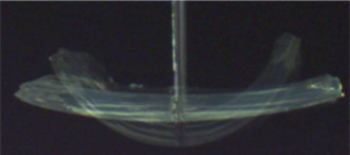
Methylcellulose hydrogels cross-linked by high-energy electrons exhibit a reverse shape memory effect, returning to their original shape—the one programmed during electron irradiation—as they cool. These hydrogels are biocompatible and are suitable for use as actuators in biomedical applications.
N. Wilharm, M. Bertmer, W. Knolle, J. Griebel, C. Elsner, S. G. Mayr
Biomimetic crosslinking of collagen gels by energetic electrons: The role of L-lysine
Acta Biomater. 140 (2025) 219-232, https://doi.org/10.1016/j.actbio.2021.09.025
The study provides insights into the cross-linking mechanism of collagen hydrogels via high-energy electrons. L-lysine serves as the central reaction site for biomimetic cross-linking. This results in stable, biocompatible scaffolds for cell-based tissue models without the use of toxic chemicals.
C. Krömmelbein, X. Xie, J. Seifert, R. Konieczny, S. Friebe, J. Kas, S. Riedel, S. G. Mayr
Electron beam treated injectable agarose/alginate beads prepared by electrospraying
Carbohydr. Polym. 298 (2022) 120024, https://doi.org/10.1016/j.carbpol.2022.120024
Using an electrospray process, hydrogel microparticles of defined size and shape are produced from agarose/alginate solutions; when combined with electron irradiation, these microparticles are further developed into injectable, sterile, and mechanically tunable biomaterials.
Equipment
- 10 MeV electron beam (Hertz Laboratory)
- Various 3D printers and bioprinters (DoD, UV inkjet)
- Confocal laser scanning microscope
- Peptide synthesis (microwave-assisted)
- Atmospheric plasma
- HPLC
- Parallel computers for modeling
Topics for Doctoral, Master's, and Bachelor's Theses
Academic theses on current topics are assigned on an ongoing basis. If you are interested, please contact Prof. Dr. S. G. Mayr.